Denis Dendy – Art in 3D

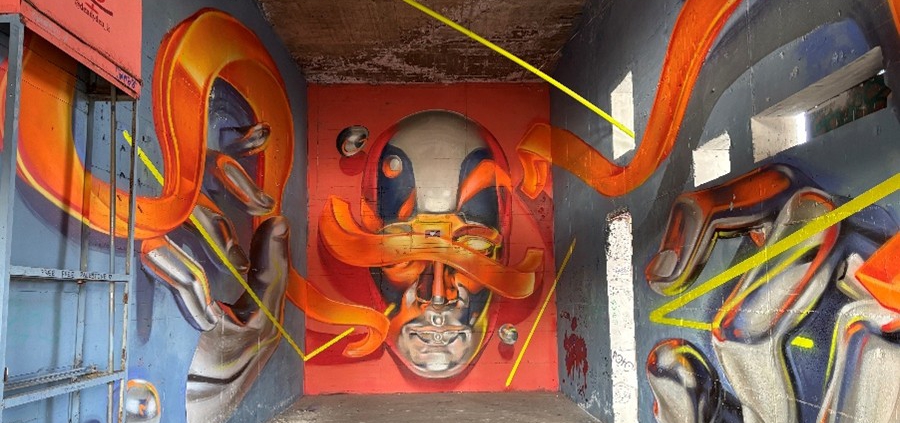
In May 2024, as part of the Live Street Art Week, Russian artist Denis Dendy transformed an entire room at Teufelsberg into a surreal vision of humanity, technology, and the creative mind. The piece is titled “Techno Temple Room”—and that’s exactly how it feels when you step inside: monumental, mysterious, and digital.

Denis Dendy was born in a small village on the Kamchatka Peninsula, the easternmost region of Russia. He discovered street art in St. Petersburg, where he immersed himself in the local urban art scene, taking part in festivals, exhibitions, and collaborations with other artists. In 2022, he left Russia, traveled through several countries, and eventually settled in Berlin.
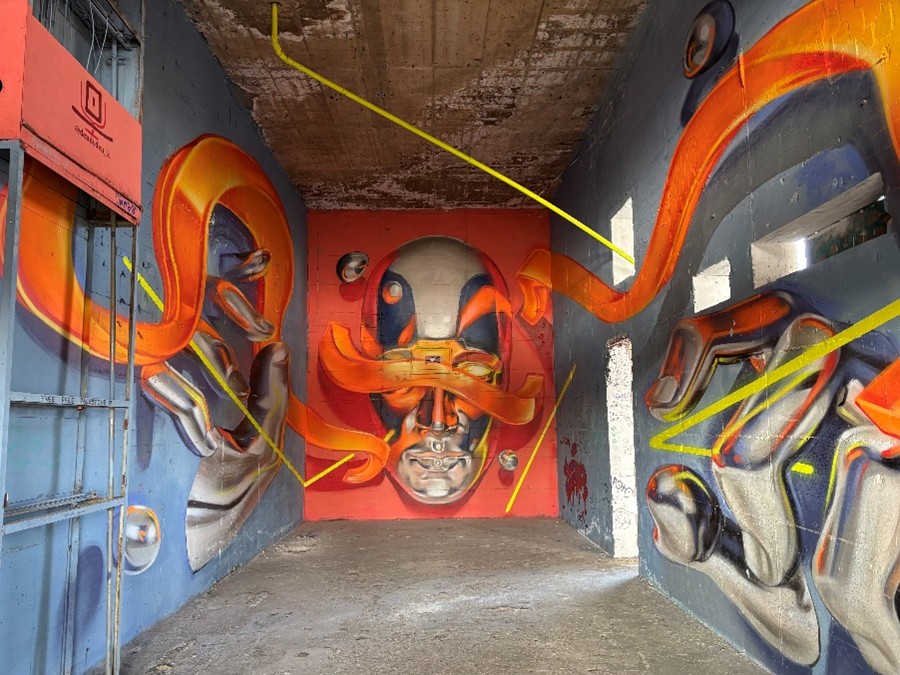
His artistic approach is clearly defined: volume, depth, and perspective. Denis merges realistic painting with geometric abstraction, experiments with 3D illusions, and uses the architecture of the space to create immersive, impactful installations. His works look like digital renderings—but they’re painted with spray cans, executed with precision and energy.

“I work in the third dimension. I start my pieces in a 3D program. For this work, I wanted to visualize the theme of the ‘creative idea.’ It shows a human made of metal—like an AI or digital entity that controls your ideas. This room is like a brain.”

With this concept in mind, Denis created a piece that stretches across all three the walls of a rectangular room. At the center, a silver, machine-like face hovers, surrounded by vivid orange energy ribbons swirling through the space. Elements seem to emerge from the walls, almost touchable. Sharp yellow lines cut through the perspective—like digital impulses in a neural network.
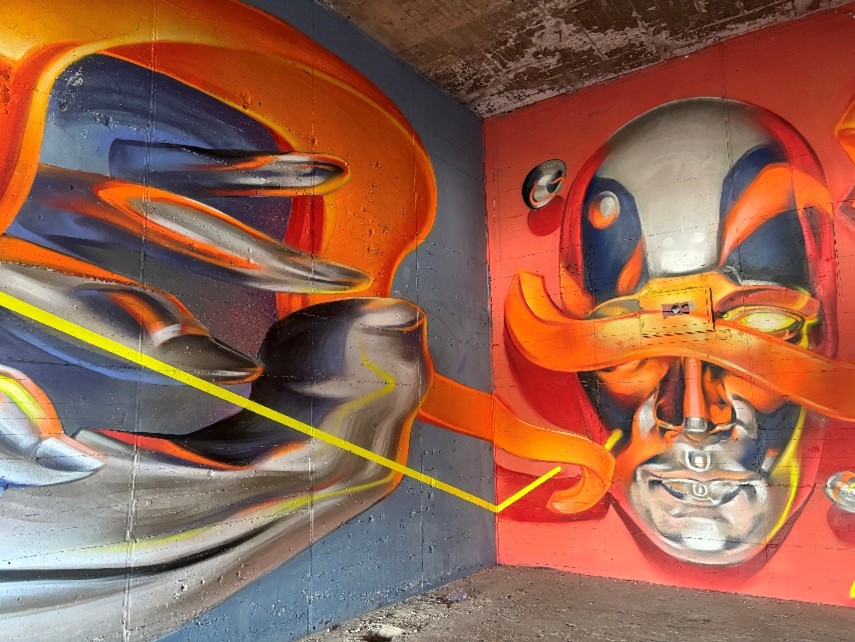
This is my second mural in Germany. For me, it’s important that my art isn’t just visually striking, but that it also carries a concept.” The “Techno Temple Room” is exactly that: a space that functions like a thought chamber. Its visual language recalls sci-fi worlds, VR interfaces, or digital dreams. At the same time, the work remains open to interpretation—a human face surrounded by motion, symbols, and energy.

Teufelsberg, with its mix of history, decay, and creative revival, offers the perfect setting. With this work, Denis Dendy didn’t just paint a room—he transformed it into a visual experience that unites technology, imagination, and aesthetics.
BustArt – Pop-Graffiti Between Past and Future

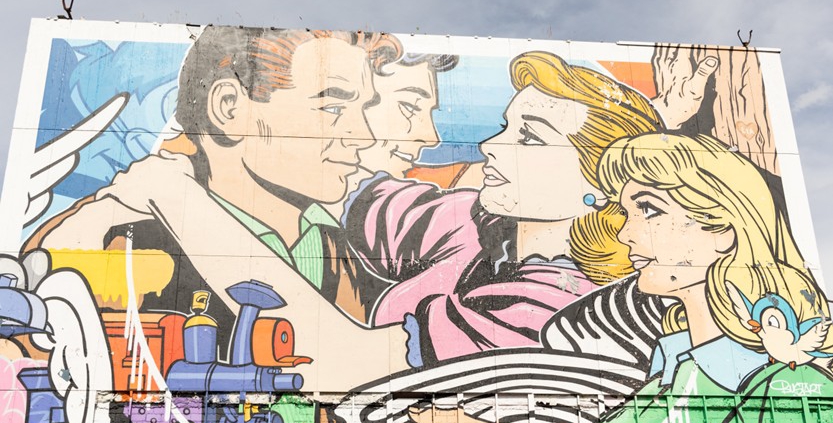
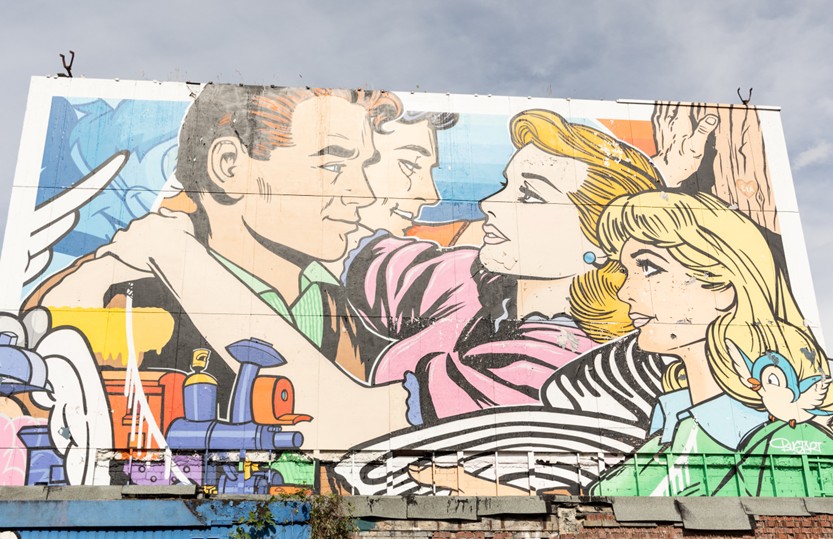
Teufelsberg in Berlin has long been a magnet for street artists from around the world. In this creative setting, BustArt, a leading figure in graffiti-pop, has left behind two remarkable works of art. His pieces from 2018 and 2023 not only showcase his technical finesse but also his distinctive ability to detach iconic characters from their original contexts and imbue them with new meaning.

The Monumental Mural

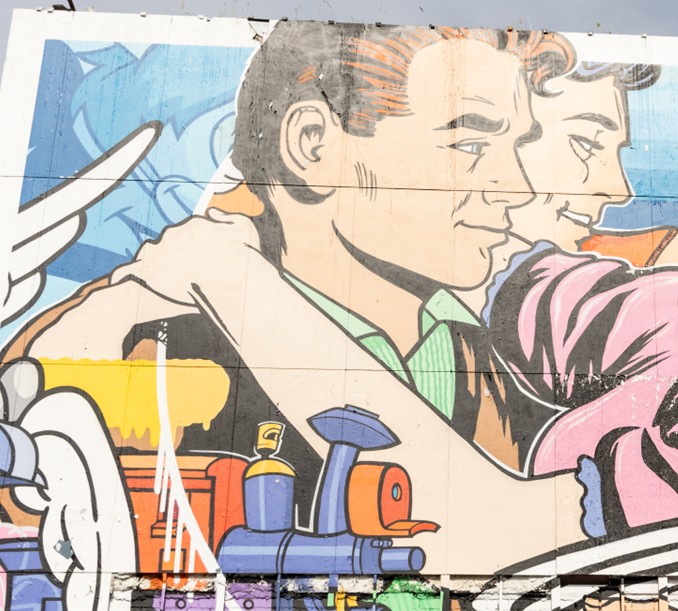
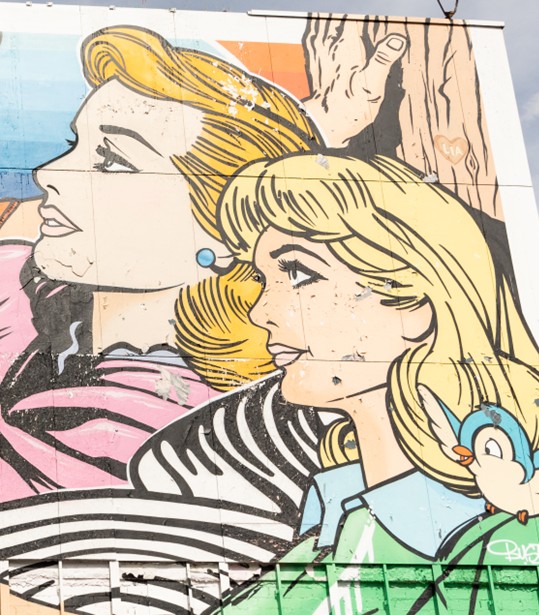
In October 2023, BustArt participated in the Street Art Festival at Teufelsberg, leaving behind an imposing artwork on the west side of the main building. Measuring 11 by 14 meters, this piece is a true eye-catcher. However, its creation was anything but easy.

BustArt recalls that the process began under ideal conditions, with sunshine and pleasant temperatures. But Berlin’s unpredictable October weather soon presented challenges: rain, wind, and cold made painting difficult. To protect himself, he improvised by converting his lifting platform into a makeshift tent, layering up with five layers of clothing, and keeping himself motivated with music. The wall’s surface proved particularly challenging, as numerous overpainted layers made drying difficult. As a result, he had to apply the paint multiple times until he achieved the perfect outcome. After six intense days—being the first to arrive at the site and the last to leave—his work was finally complete.

The mural features BustArt’s signature blend of pop art, graffiti, and iconic cartoon figures. At its center is a large, dynamic cartoon character, vividly brought to life with bold colors and strong contrasts. Surrounding it are various pop-cultural elements: comic book heroes, distorted advertising icons, and abstract patterns reminiscent of classic graffiti tags. His “cut and paste” technique, in which he merges elements from different contexts, creates a powerful visual language. The overlapping layers of paint and intentional blurring add depth to the piece, continuously revealing new details upon closer inspection.

A Pop-Cultural Explosion

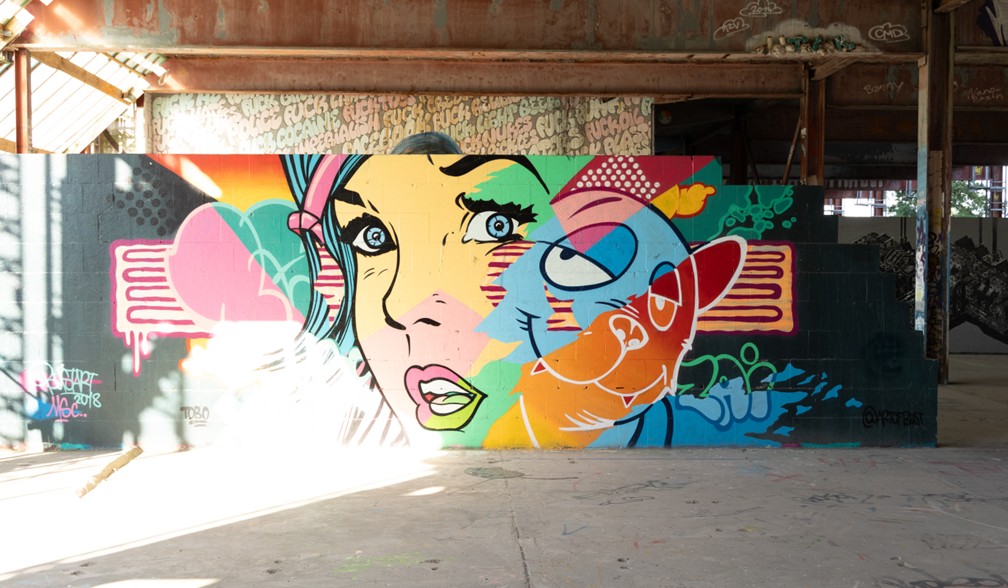
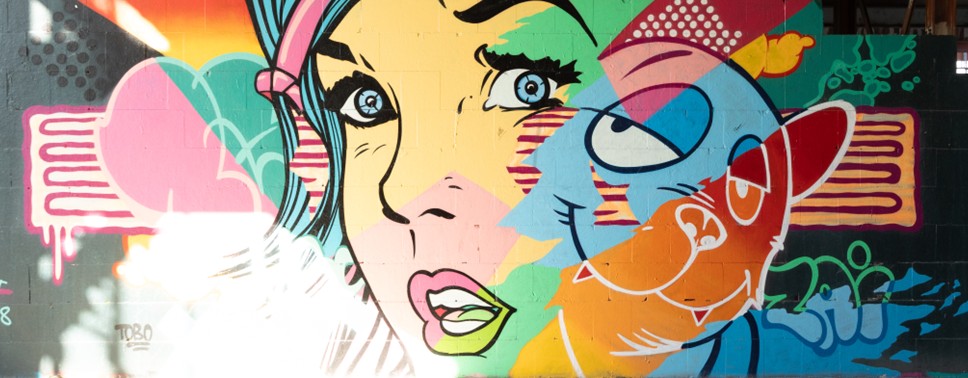
Back in 2018, BustArt had already left his mark at Teufelsberg with another artwork, located on the first floor of the gallery. It depicts a woman with wide, startled eyes, her expression conveying surprise or even shock. Beside her, a mischievous cartoon cat peers playfully into the scene. The striking colors—vibrant blue, bright yellow, and deep red—create a visually intense impact. The dynamic composition, where various visual elements seamlessly blend, gives the artwork a captivating energy.

This piece is a prime example of BustArt’s earlier creative phase, during which he focused heavily on stencils and figurative motifs. The clean lines and bold style evoke the aesthetic of vintage comic strips, fused with modern street art elements. Here, too, his talent is evident in recontextualizing familiar figures, prompting viewers to see them in a new and unexpected way.

BustArt began his career in 1999 with traditional graffiti before evolving his style through travels across Europe. In Amsterdam, he found a creative home, fully dedicating himself to his art. Over the years, his style has shifted from political stencils to elaborate compositions that merge classic graffiti elements with pop art and cartoon imagery.

For BustArt, street art is more than just artistic expression—it’s direct communication with people on the street. His goal is to create surprising and colorful works that make viewers think. He has already made his mark in cities like New York, London, Paris, and Mumbai, leaving behind traces of his unmistakable style worldwide.

The two artworks at Teufelsberg represent both his artistic evolution and the vibrant street art scene in Berlin. They highlight how this location continues to attract creative minds from around the world, telling new stories in color with every brushstroke.

Devita – Women in Focus

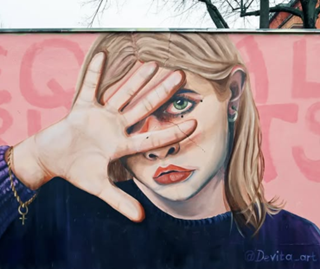
In March 2024, the Power of Female Art Festival transformed Teufelsberg into a vibrant canvas for bold artistic statements. One of the standout artists this year was Devita (Devata Pätsch), whose striking mural captivates visitors.

Colour, Expression, Emotion

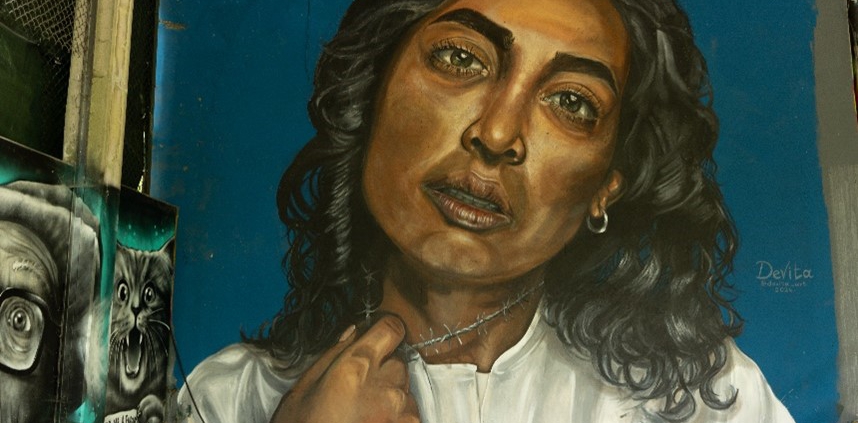
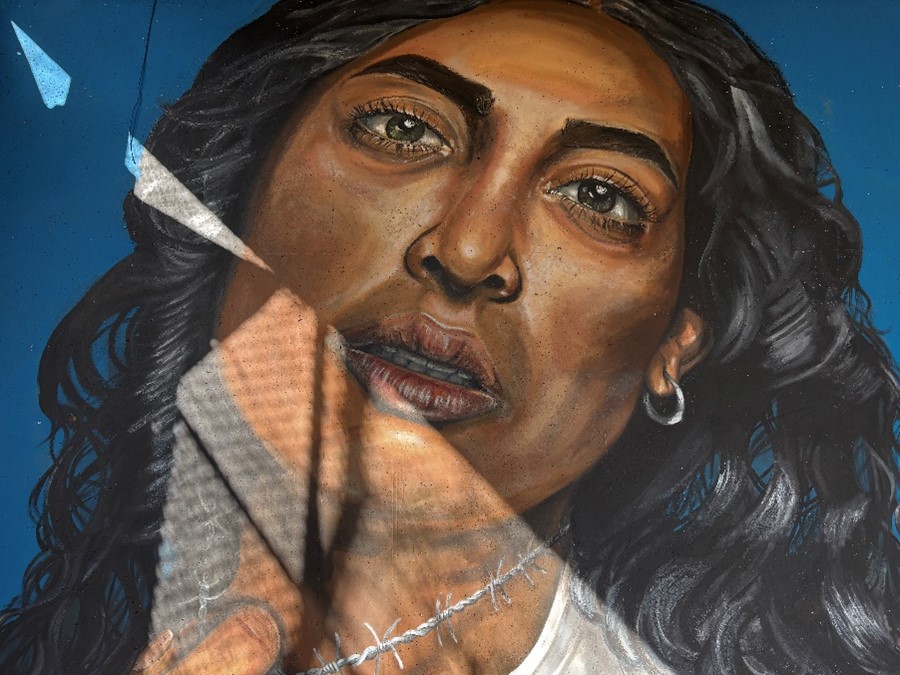
The mural Devita created for the festival at Teufelsberg immediately commands attention with its intense expression and deep symbolism. It depicts a woman with dark, flowing hair, her gaze both piercing and vulnerable. One of the most striking details is the gesture of her hand touching her throat, which is wrapped in barbed wire— a powerful symbol of oppression, resistance, and the struggle for self-determination.

The portrait’s earthy, warm tones contrast with a deep blue background, further enhancing the intensity of the image. Through subtle nuances in facial expression and body language, Devita forges a strong emotional connection between the artwork and its viewers. Her technique merges realistic portraiture with narrative symbolism, seamlessly aligning with the festival’s themes.

Her contribution to the Power of Female Art Festival 2024 exemplifies her artistic mission: to portray women in all their complexity, make their strengths and struggles visible, and challenge societal structures.

The Artist Behind the Mural

Born in 1985 in Cuxhaven, Devita now lives and works in Berlin. She studied art education in Osnabrück and Leipzig, specializing in visual media. Her travels and extended stays in Spain, Argentina, and Mexico deeply influenced her artistic perspective and thematic choices, shaping the distinctive style she is known for today.

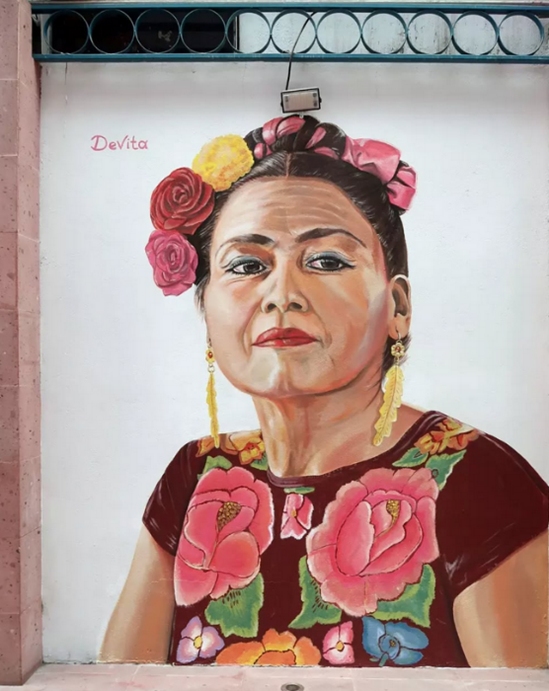
A central focus of her work is the depiction of female figures. Her portraits go beyond realism—they carry deeper messages. Devita explores themes of emancipation and ingrained gender roles, often incorporating folkloric elements that add layers of meaning and power to her art.


Her murals can be found in cities such as Berlin, Leipzig, Munich, Melbourne, and Adelaide. Integrated into the urban landscapes of these places, her works give a voice to those whose stories are often unheard.

With her mural at Teufelsberg, Devita has not only created a visual highlight of the festival but also made a strong artistic statement. Her work moves, provokes thought, and lingers in the minds of those who see it—exactly what the Power of Female Art Festival stands for.

Sr. Papá Chango – Fantasy Meets Reality

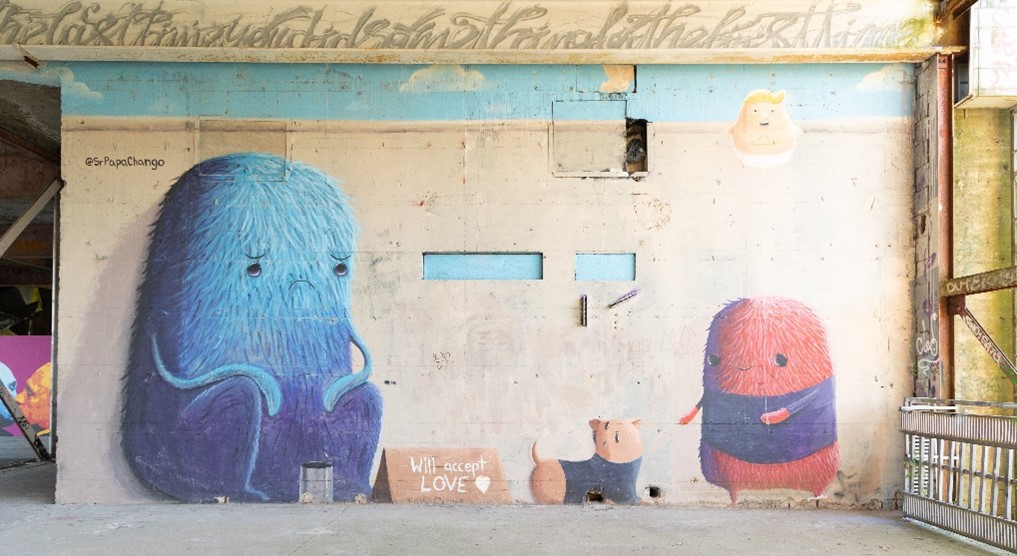
Since 2019, a very special piece by Mexican artist Sr. Papá Chango has adorned the first floor of the gallery at Teufelsberg. With his colorful, almost childlike aesthetic, the artist creates a scene that is both touching and thought-provoking. His work blends fantasy with everyday life, delivering a clear message of humanity, openness, and global connection.

A Scene Full of Emotion

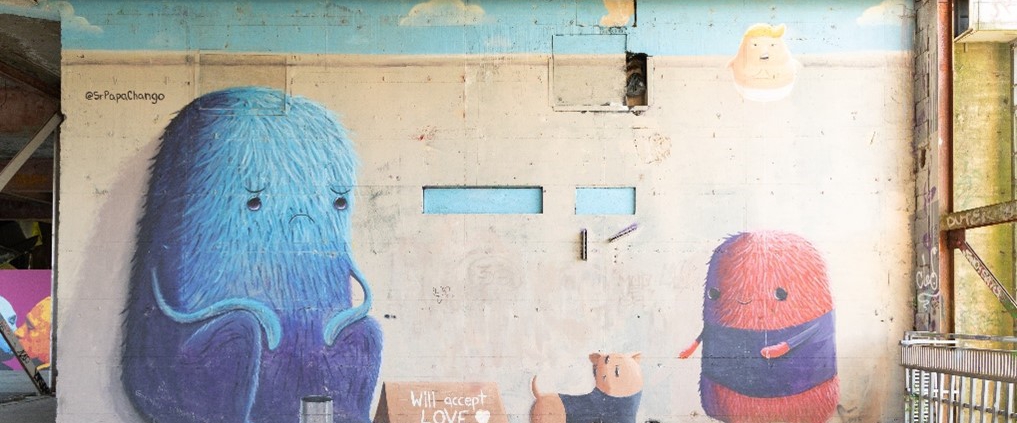
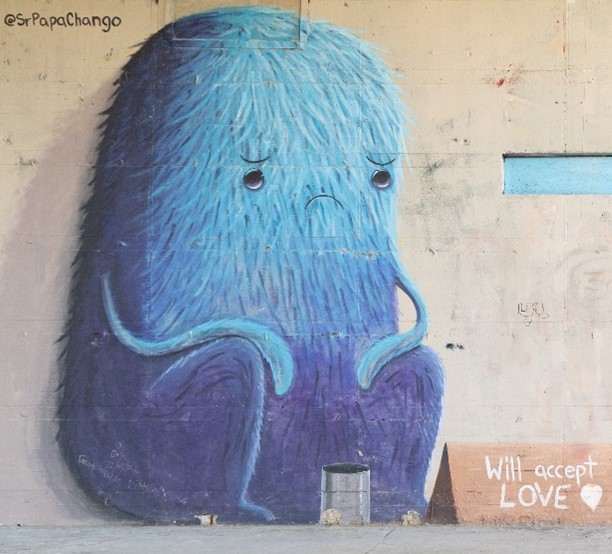
The mural, titled “No Borders! Will Accept Love,” depicts a group of whimsical, furry creatures in vivid colors. On the left sits a large, sad-looking blue figure with its head lowered. In front of it is a sign reading “Will Accept Love“—a message that resonates deeply in its simplicity. Opposite, a smaller, red-orange figure extends its arms as if offering comfort or friendship. Between them, a small dog sits—a universal symbol of loyalty and unconditional love. The scene conveys a touching mix of melancholy, hope, and connection.

The title “No Borders! Will Accept Love” adds an even deeper meaning to the artwork. At first glance, “No Borders” could be interpreted as a political statement—a critique of physical borders between nations. However, the mural speaks a more universal language: What boundaries do we build in our everyday lives? It highlights social barriers, exclusion, and the invisible walls that separate people.

The blue figure does not just look sad—it seems isolated, overlooked, perhaps even ignored. Yet, it does not ask for money or material aid, but for something far more fundamental: love. It serves as a quiet reminder that every human being, regardless of background or social status, craves belonging and affection. With this piece, Sr. Papá Chango encourages us to reflect on our own walls and to recognize those we often overlook—those who may need just a little more kindness and empathy.

Art as a Language for Global Issues

Sr. Papá Chango is a Mexican artist based in Berlin. His work is characterized by a unique fusion of fantasy and reality, bringing colorful, lively worlds to life with characters that may appear playful at first but carry profound messages.

“It is very important to me to raise awareness of current global issues. That’s why I use my innocent murals to inform clearly and simply—with the intention of touching both the heart and the mind.”

His art goes beyond aesthetics—it serves as a tool for making social and political issues visible. Borders, social injustice, and human connection are recurring themes in his work. The mural at Teufelsberg powerfully reinforces this idea: Love knows no borders, and everyone deserves compassion and kindness.

Over the past six years, Sr. Papá Chango has exhibited his work around the world—from Germany to Spain, Romania, Australia, the Netherlands, Belgium, Colombia, and Mexico. His goal is not only to leave behind artworks but to actively engage with communities and individuals.

With his mural at Teufelsberg, he has become part of Berlin’s urban art culture, leaving a lasting message behind. His work reminds us that empathy, love, and unity are universal values—transcending nationality, borders, and language. The mural invites us to pause, absorb its message, and reflect—perhaps even consider how we can bring a little more love into the world ourselves.